🎉 Up to 70% Off Selected ItemsShop Sale


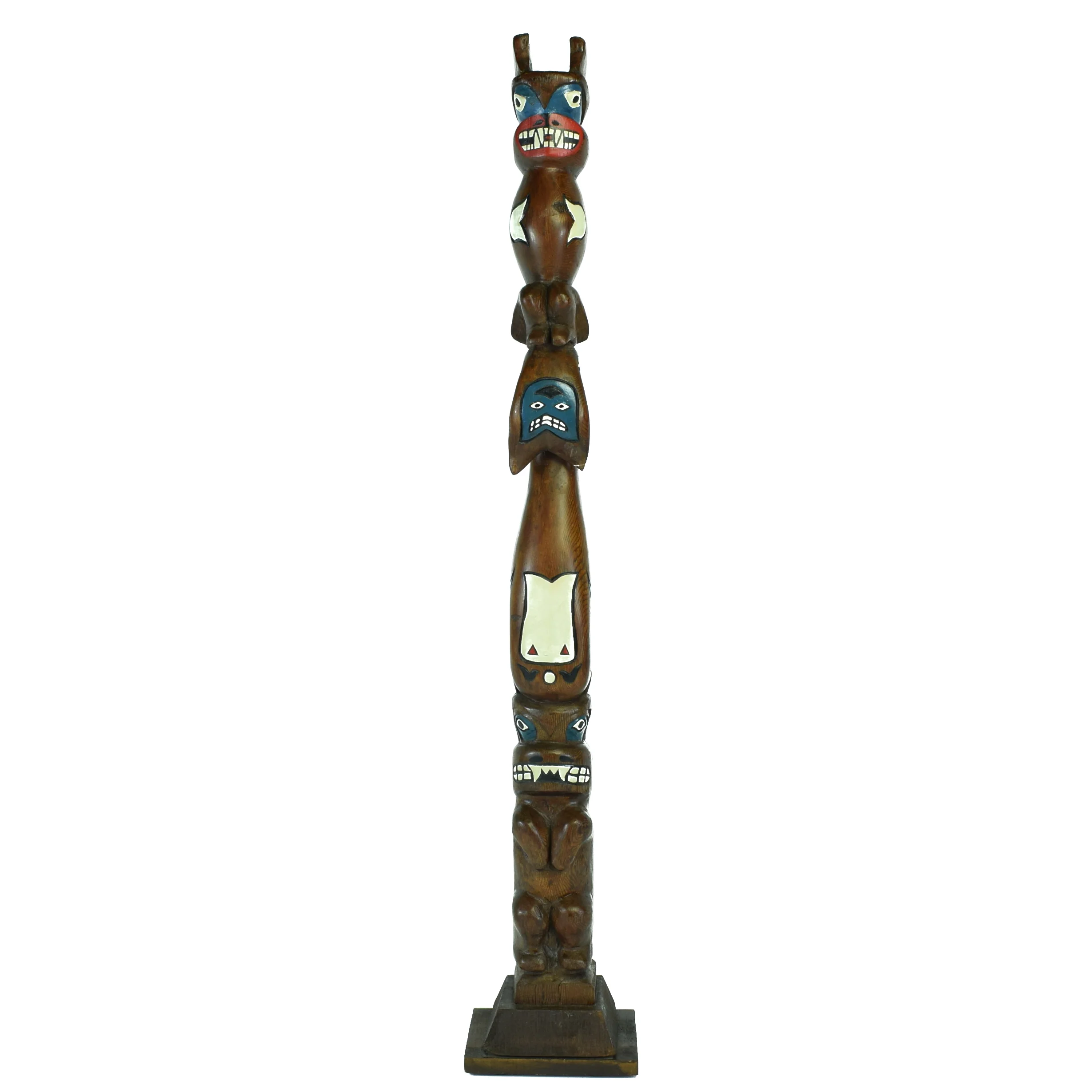
Ditidaht/Nuu-Cha-Nulth Totem by Raymond Williams
A finely crafted model pole by Ditidaht/Nuu-chah-nulth master carver Raymond Williams (ca. 1933-1988), the father of the current generation of Williams carvers. Raymond Williams was the son of Sam Williams (c.1884-1979), the originator of the distinctive Williams family style of carving.
This pole is rendered in Raymond’s later style, defined by his deep carving and liberal usage of brightly colored paints. The pole is an iteration of the Tlingit Seattle Pole of Pioneer Square, a popular motif for Seattle-based model pole makers. The verso features Ray’s carved signature, a stamp that reads “Hand Carved/Indian Made” and “From the World Famous/Ye Olde Curiosity Shop/Seattle Washington/Since 1899.” 19"H x 5"
Raymond Williams was the son of Sam Williams, a Ditidaht carver (c.1884-1979) who was the originator of the distinctive William's family carving style. Raymond, also Ditidaht and Nuu-chah-nulth, carved in Seattle and Nitinat Lake, British Columbia, Canada. His work is typically characterized by many small cuts, sometimes cutting through the surface to the back. He was a prolific carver of model poles, influenced by his father's work, and developing his own style.
This pole is rendered in Raymond’s later style, defined by his deep carving and liberal usage of brightly colored paints. The pole is an iteration of the Tlingit Seattle Pole of Pioneer Square, a popular motif for Seattle-based model pole makers. The verso features Ray’s carved signature, a stamp that reads “Hand Carved/Indian Made” and “From the World Famous/Ye Olde Curiosity Shop/Seattle Washington/Since 1899.” 19"H x 5"
Raymond Williams was the son of Sam Williams, a Ditidaht carver (c.1884-1979) who was the originator of the distinctive William's family carving style. Raymond, also Ditidaht and Nuu-chah-nulth, carved in Seattle and Nitinat Lake, British Columbia, Canada. His work is typically characterized by many small cuts, sometimes cutting through the surface to the back. He was a prolific carver of model poles, influenced by his father's work, and developing his own style.
PERIOD: Unknown
ORIGIN: Northwest Coast - Nuu-chah-Nulth, Native American
SIZE: 19"H x 5"
$3,500.00
Ditidaht/Nuu-Cha-Nulth Totem by Raymond Williams—
$3,500.00
Product Information
Product Information
Shipping & Returns
Shipping & Returns
Description
A finely crafted model pole by Ditidaht/Nuu-chah-nulth master carver Raymond Williams (ca. 1933-1988), the father of the current generation of Williams carvers. Raymond Williams was the son of Sam Williams (c.1884-1979), the originator of the distinctive Williams family style of carving.
This pole is rendered in Raymond’s later style, defined by his deep carving and liberal usage of brightly colored paints. The pole is an iteration of the Tlingit Seattle Pole of Pioneer Square, a popular motif for Seattle-based model pole makers. The verso features Ray’s carved signature, a stamp that reads “Hand Carved/Indian Made” and “From the World Famous/Ye Olde Curiosity Shop/Seattle Washington/Since 1899.” 19"H x 5"
Raymond Williams was the son of Sam Williams, a Ditidaht carver (c.1884-1979) who was the originator of the distinctive William's family carving style. Raymond, also Ditidaht and Nuu-chah-nulth, carved in Seattle and Nitinat Lake, British Columbia, Canada. His work is typically characterized by many small cuts, sometimes cutting through the surface to the back. He was a prolific carver of model poles, influenced by his father's work, and developing his own style.
This pole is rendered in Raymond’s later style, defined by his deep carving and liberal usage of brightly colored paints. The pole is an iteration of the Tlingit Seattle Pole of Pioneer Square, a popular motif for Seattle-based model pole makers. The verso features Ray’s carved signature, a stamp that reads “Hand Carved/Indian Made” and “From the World Famous/Ye Olde Curiosity Shop/Seattle Washington/Since 1899.” 19"H x 5"
Raymond Williams was the son of Sam Williams, a Ditidaht carver (c.1884-1979) who was the originator of the distinctive William's family carving style. Raymond, also Ditidaht and Nuu-chah-nulth, carved in Seattle and Nitinat Lake, British Columbia, Canada. His work is typically characterized by many small cuts, sometimes cutting through the surface to the back. He was a prolific carver of model poles, influenced by his father's work, and developing his own style.
PERIOD: Unknown
ORIGIN: Northwest Coast - Nuu-chah-Nulth, Native American
SIZE: 19"H x 5"